Tuesday, October 4, 2011

The Heart is a Lonely Hunter, Carson McCullers


The Heart is a Lonely Hunter
Read this book, and you will visit this sad, lonely group of people, living in a economically depressed town in the South, during the Great Depression, during a time of racial injustice, hunger for many, and yes, lack of health care. 

I think if you would like to appreciate how wonderful it is to live in our current Great Recession, you should read this book.  In the 1930's, lack of health care meant that there was no hospital that would save you; no doctor to see if you didn't have the money.  Hunger was not relieved by food stamps.  Jobs were scarce.   Life was tough.

This novel is centered around five main characters.  Four of the characters are strongly passionate about their aspirations.  There is the old black Dr. Copeland who believes in Marxism, the young Mick Kelly who wants to compose music, crazy Jake Blout who wants to teach people about economic injustice in America, and Biff Branon who through a true love for his fellow man wants to ease suffering.  These characters all gather around their friend, deaf-mute John Singer, of whom each believes he understands their passions.  He doesn't.  As you read this book, you believe that each of their aspirations can be obtained.  In the end, McClullers crashes this, and doesn't give us much hope for any of her characters in this novel.  It is surprisingly entertaining for a novel with about zero plot, though one could argue that there are five strong subplots.  Each subplot tells a sad story through a purposeful character.

This is an Oprah Book Club book, the perfect place to find every sort of human misery put into literature.  The stories of the five main characters are told to make, what I think, is a point that we are basically inconsequential, sad creatures who struggle in a horrible world.

The following is referring to Biff, the do-good er and owner of an all night cafe.

"For in a swift radiance of illumination he saw a glimpse of human struggle and of valor.  Of the endless fluid passage of humanity through endless time.  And of those who labor and of those who .. love.  His soul expanded.  ... Between the two worlds he was suspended.. The left eye delved narrowly into the past while the right gazed wide and affrighted into a future of blackness, error and ruin"

I think I'll throw myself off a bridge now.  Nah, maybe just have a glass of wine to kill the pain.

Yes, this book is a masterpiece.  It is well written, makes you care about the rich characters, has a point, keeps you interested and turning pages as the motivations and horrendous problems are laid out on these pages.  It would make a great discussion book.  However, for a book club pick, my personal preference would be for something with more hope and fun.

I would like to recommend To Kill a Mockingbird, by Harper Lee as an alternative.

To Kill a Mockingbird


Readers, do you know of a great book, set in depression era America, that leads you with more hope that you would recommend?

Monday, September 26, 2011

Retired Math Professor Breaking Bad! Pot Trafficking, Explosions, Guns, Hookers, Prison!


As a new-bee first semester University of New Mexico student, 17 years old and terrified of Calculus I and the thick 1000 paged text book, I watched in trepidation as this tall, long haired, blue jeaned, leather booted professor sauntered into the classroom.  This was a time where calculators were most likely pencils or slide rules, Mitchell Hall (one of the classroom buildings) wasn't wired and punch cards were used to communicate with computers.  I watched, as he slowly paced cat like, from one side of the room to the other, occasionally licking his lips, obviously in deep thought (one could only hope it wasn't because he was hungry for Freshmen).

Picking up a piece of chalk, we all watched in anticipation of a complex formula, or convoluted Mathematical idea that would cause us to rush to the registrars afterwards to find a new section, or perhaps change our major (what good is engineering anyway?).  Turning to face us before writing, he most seriously stated "This is a very important book that everyone here should read".  Our hearts expired, please not another book we thought.  Back to the board he wrote, "Zen and the Art of Motorcycle Maintenance."  Smiling, we knew this would be an interesting math class, and he did not disappoint us.

I have to confess, I haven't read that book, and he still passed me onto Calculus II.  But, what I did read was his 2005 self published book, "The Golden Years of Jess Martin". I loved it, but then I always liked listening to Jeff talk, and his voice in the book is the same as his voice in person.

I read this book in 2008, so I will not review this from my memory.  Instead, I will copy the review I wrote back in 2008 from Amazon.  However, separate from that review, I recall that it got really wild and crazy, and I've always wondered if the fictional blowing up of the humanities building (that is the building where the Math department used to live) had a deeper meaning.  The end of the book didn't hold together as well for me as the first half, though the whole book was really fun to read.

This would not make a good book club discussion book, but is a dirtier, lighter "escape from reality" book to read.

So, here is the Amazon review (dang it, the Amazon criminals won't let me copy and paste it, so here is a retype):

This was an extremely entertaining book, fast paced, unpredictable, with great characters. The characterization of Jess and the people he deals with was realistic;  written by an author who understands people and their motivations.  You will even find yourself having sympathy for a double crossing hooker!

This was similar to Breaking Bad, a new cable series, but where the chemistry teacher (turned bad) uses chemicals to solve his drug business complications, Jess uses mathematical logic that has tastes of higher level thinking to conquer the messes that go hand in hand with pot trafficking.

I found the settings of a prison in CA, the bar and society in Southern NM near the Mexican border well described and interesting.  I only wish Jess could have retained some of his innocence, as I really liked the character who was a newbie, but after enough time in the business, it just wasn't possible.

I think the best thing about this book was that I couldn't predict what was going to happen next.  I am hoping for a sequel.

Thursday, September 15, 2011

The Poisonwood Bible, Barbara Kingsolver


The Poisonwood Bible
The Poisonwood Bible is a great discussion book.  It is well written, interestingly set in the Belgian Congo before, during and after the transition from a Belgian territory to a dictatorship when the country was lead by a self serving ruthless dictator, Mubutu and became known as Zaire.  The tale of this countries' people was spun using a fundamentalist baptist missionary family's struggles in a primitive village, Kilanga.

A sad event is foretold in the first chapter of the book.  The story then proceeds in the first person, told from family members, Orleanna Price and her four daughters, weaving you along subplots. All paths lead you to the sad event that will ruin everyone's lives.  This book is read the way one gawks at a car accident inclusive of twitching body parts, fire and blood.  The story spans their lives starting with their pilgrimage to the Congo as a young family in 1959.  It is interesting that there is no chapter where we hear the story told by Nathan, the father.

This was an exciting book filled with life and death moments. Learning about the hardships of surviving in Africa helps to broaden one's view of the importance of things American's take for granted, such as not being killed by the local wildlife and having not just good food to eat but enough food to eat.

It is a great book, so why should I follow this with more to be said?  To not mince words, this book was godless.  Well, perhaps worse than godless. Kingsolver needs to be certain that she has chosen the right side of the good and evil, believer and nonbeliever fence, as she has certainly taken sides.  I think that the true point of this book is to convey her idea that the missionaries in Africa are the real sinners.  That there is no God, the only salvation in life is ourselves, and forgiveness even from the regrets we experience in our own lives is only attainable through our own resolve to forgive ourselves.  With this is revealed the life of the true Atheist.  "The teeth at your bones are your own, the hunger is yours, forgiveness is ours." 

Why did she call this the Poisonwood Bible?  Only Kingsolver knows for sure, but I'll take a guess at this.  The poisonwood tree in the Congo is a pretty nasty tree that causes one to break out in horrible painful boils.  The Bible is a book of truth, when crossed by a poisonwood tree causes something quite horrible as per her tale.

Kingsolver makes it clear that the missionary work by the main character in this book, Nathan Price, was a horrible sin against the Congolese people. Granted, Nathan was a twit.  He was inflexible in light of incredible African diversity, making him truly horrible at communicating God's love to these people. At the end of each of his church services, he says "Tata Jesus is bangala", where the word bangala can mean precious but can also mean poisonwood, Kingsolver's joke on Nathan.

I've no doubt that there were many missionaries like him with good intentions of sharing their beliefs with other people but insensitive to the culture of the communities.  However, I believe God to be kind and loving of his creation (one caveat, this doesn't mean that we will not suffer and die, as this is part of our biological existence).  The belief in God's condemnation based on the fact you may be born in Africa instead of a Christian community somewhere else is clearly nonsense. God is greater than our own biblical interpretation, and the belief that God loves all of us, that God is faithful and that only God can judge is my foundation.  I see no reason that Kingsolver found the need to crucify God based on some men's narrow interpretation of the bible.

So, in that light, I found the book without soul.  However, Kingsolver is truly a Queen of writers.  My favorite book of hers is Animal, Vegetable, Miracle, a true tale of family gardening.
Animal Vegetable Miracle

Friday, September 2, 2011

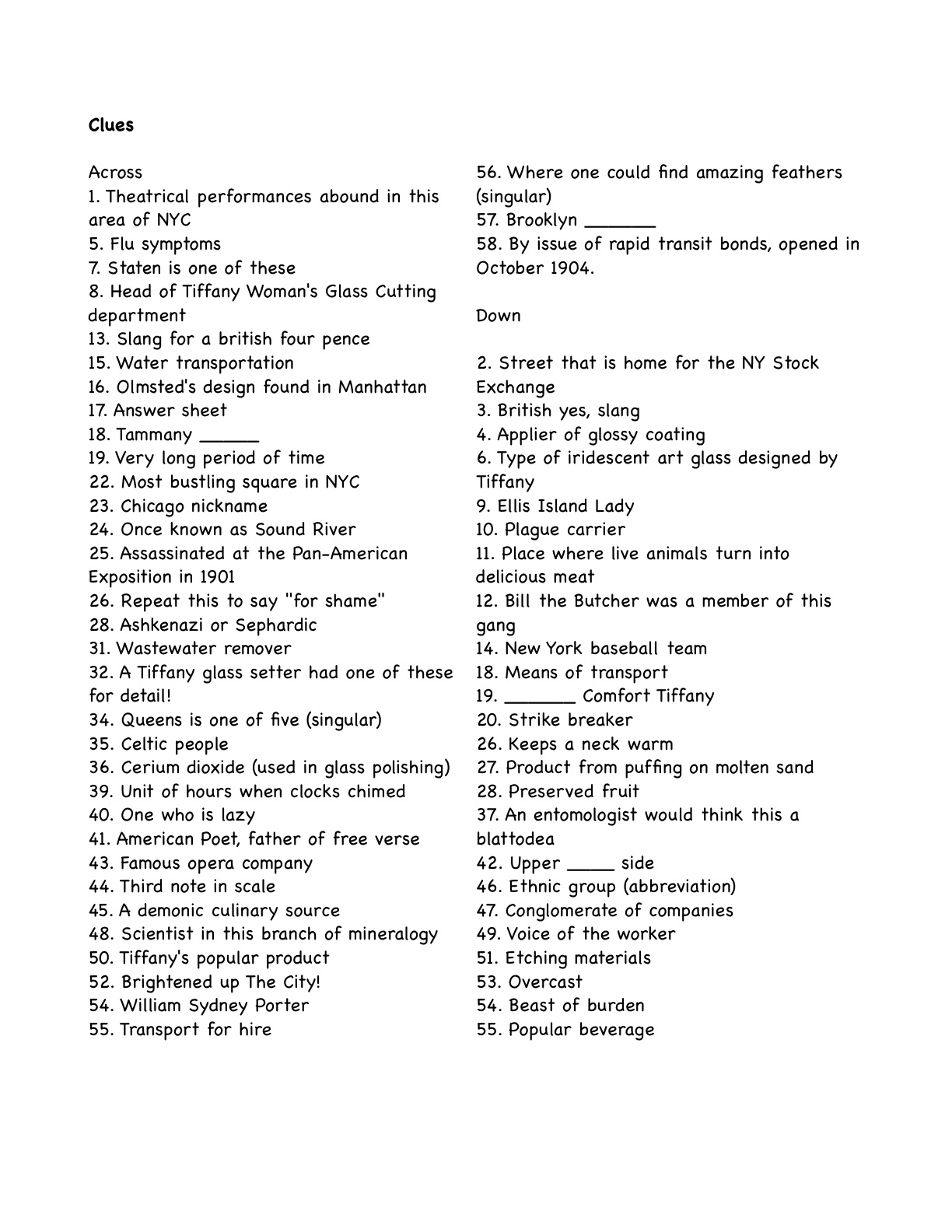
How to make a crossword puzzle, and solution for Tiffany's Turn of the Century New York

Hi all.  Here are the solutions for the puzzle.  It was fun to make, and I hope it was fun to do too.  Though, I have to admit, I would have to use Google for a few of the entries (and I used Google to come up with a few of the entries).  Also, it took quite some time, but I figure anything worth anything will take some time to do.

One puzzle about making this puzzle was to figure out how to do this on the computer.  So, since this in itself was a puzzle, I will also tell you about my solution!  I'll say, if anyone has some shortcuts to this, I'm game, but my rule is that it can't include software that costs money.  That will make this puzzle too easy.
 
First, I started with a web site that gave me a starting point for the puzzle.  I gave the site 20 words, and it fit 17 of them together and gave me a pretty bad puzzle.  That is, there were few words that had more than one connection to another word.  This is the site that I used, which by the way, I think is a pretty good site: http://puzzlemaker.discoveryeducation.com/CrissCrossSetupForm.asp

Next, I printed this out and thought about some more words that would fit the puzzle theme.  I drew on the picture by hand until I had fit in quite a few theme words.  But, still I needed more connection words to make the puzzle good.

Step three was another website that was great for finding those connections words.  This site allows you to search for dictionary words of a certain length that have your special characters in the right place.  For example, you can type in h**p and it will return all the words that match this pattern, say harp, hasp, heap, help, etc....  This site is as follows:  http://www.thewordfinder.com/crossword.php

OK, so now I had my answer sheet.  Next, I created a table in Open Office and made it look like a grid.  I figured out how to superscript characters so I could type my number 1., 2., etc to identify rows and columns.  I created the clues, colored all unused squares so it looked nice, and I have to say this was full of errors and took a very long time.  I could see how puzzle software would be a good tool to have at this point.

Then, the last problem was how to share this.  I use a Mac, so had no problem saving pages in pdf format.  You can select this option whenever you print a page.  Then, my Mac pdf reader allowed me to save in jpg format, which is what is posted below.  Total software cost - $0.00.  Total time cost - ridiculous.


Sunday, August 21, 2011

The Help, Kathryn Stockett

As our book club organizer and lover of books, The Help by Kathryn Stockett hit the top of my list for the richest discussion book for our group in 2010.  I am glad it was made into a movie for all those souls who don't or won't read the book, but I just can't imagine that the movie could be better than the book.  On the other hand, I will never be able to judge because I've read the book and all the suspense and surprises have been reveled to me.

This great book is extraordinarily rich in character development, with a width of characters spanning black and white, caring and deviously racist, selfless and self serving, all working to spin Stockett's tale about a young journalist, Skeeter, who is writing an undercover story about the maids in Jackson Mississippi in the early 1960's.  Skeeter's story is great, but the stories about the maids are real page turners. I can't recommend this book enough. 

This is a setting and era that many of us need to be reminded of with a clear nonprejudicial mind.  Though this is a story taking part in the historical era of Jim Crow Laws, at a time where many white people believed with all their hearts that black people were less intelligent, and not deserving of simple human considerations (such as using the same toilet as they, or drinking from the same water fountain, or sitting in an adjacent bus seat), we need to also be understanding to the era of ignorance.  However, I can't seem to extend any amount of understanding to some of the hateful destructive women in this novel.

Many white people did not know better, just as many people today are victims of their own background and ignorance.  We can move these issues to the year 2011, where this is not a white problem, but a problem that spans races.  It is a problem of poor education, socio-economic challenges and deep cultural prejudice.  Today, "The Help" comes in many shades of colors, so we should take a lesson of humanity away from this book.  In other words, we are all human and deserve to be treated as such.

I have discussed one of many issues touched in this book.  However, read this book and you will have incredible diverse discussion material.  Read this and you won't be able to put it down.  This book will always have a place in my private library.

Sunday, August 14, 2011

Turn of the Century New York City Crossword Puzzle for you!

Hi there book friends!  I've worked super hard, and made a crossword puzzle based on the book Clara and Mr. Tiffany written by Susan Vreeland.  The puzzle keeps with the theme of 1900's New York City.  It was a lot of fun to make, but more work than I thought!  I will post the answer key in around a week.

I would use google to help with some of the answers (esp if you didn't read the book).   Not all clues are applicable to the book, but they keep in the theme.

If you would like a pdf version, email me and I will be happy to send that to you. At this time, I do not have a link to this file that you can download ;-(

Wednesday, August 10, 2011

Destruction, Disaster, Armageddon, No Hope At All!

That is my summary of this book!  Before I go and say some good things about The Story of Edgar Sawtelle, I would like to make a definite statement that this would not be a good book club read - at least not the kind of book club I would like to enjoy, where the novel is considered a work of art that has the ability to help enhance and understand our own lives through member relationships and discussion. 

First, it was well written, set in a rural Wisconsin dog breeding and training farm.  Nice, right?  Then, let us make this even more interesting with great and unusual characters.  As this 560 page novel worms its way into the reader's life, he/she learns to care for these wonderful characters.  The most interesting is Edgar, a mute boy who is quite literate in writing and signing.  Almondine, Edgar's closest friend and canine nurse maid, has a true voice in the story.  There are other interesting dogs and Edgar's caring parents, Trudy and Gar.  Time is spent developing the history of the family and the farm.  Wroblewski even gives us a great plot with the addition of a villain, Uncle Claude!  All these pieces make a wonderful story.

Now, let me explain why this book ticked me off so much.  In the last chapter, he totally ruins his plot, the tale's mood, and any hope for any of the characters. I would never suggest to an author that his ending should change.  After all, this is fiction, the authors slate, to do with as he pleases.  Frankly though, I feel betrayed by this book's ending, to the point that twenty years from now, if I have the pleasure of still being part of the human race, I will remember the horrible ending to this book - it was that dramatic.  I will never again read another book by Wroblewski.  Others can enjoy his art, and then see him throw a stinky dog turd right into the middle of the Mona Lisa.  Crap.  I won't make the same mistake twice.

Since this blog is about good books to read, I would like to suggest Watership Down.  This classic book, published in 1972, is an excellent read about talking rabbits who have been displaced from their warren by a farmer.  This novel is totally worth the 608 page reader investment.  It is a classic that can be reread with great pleasure.  So, readers, spend your time reading something that is truly a great book.  Though talking rabbits sounds crazy, the book is really about human nature and ethics and is enjoyable for adults as well as high school students.