Sunday, August 14, 2011

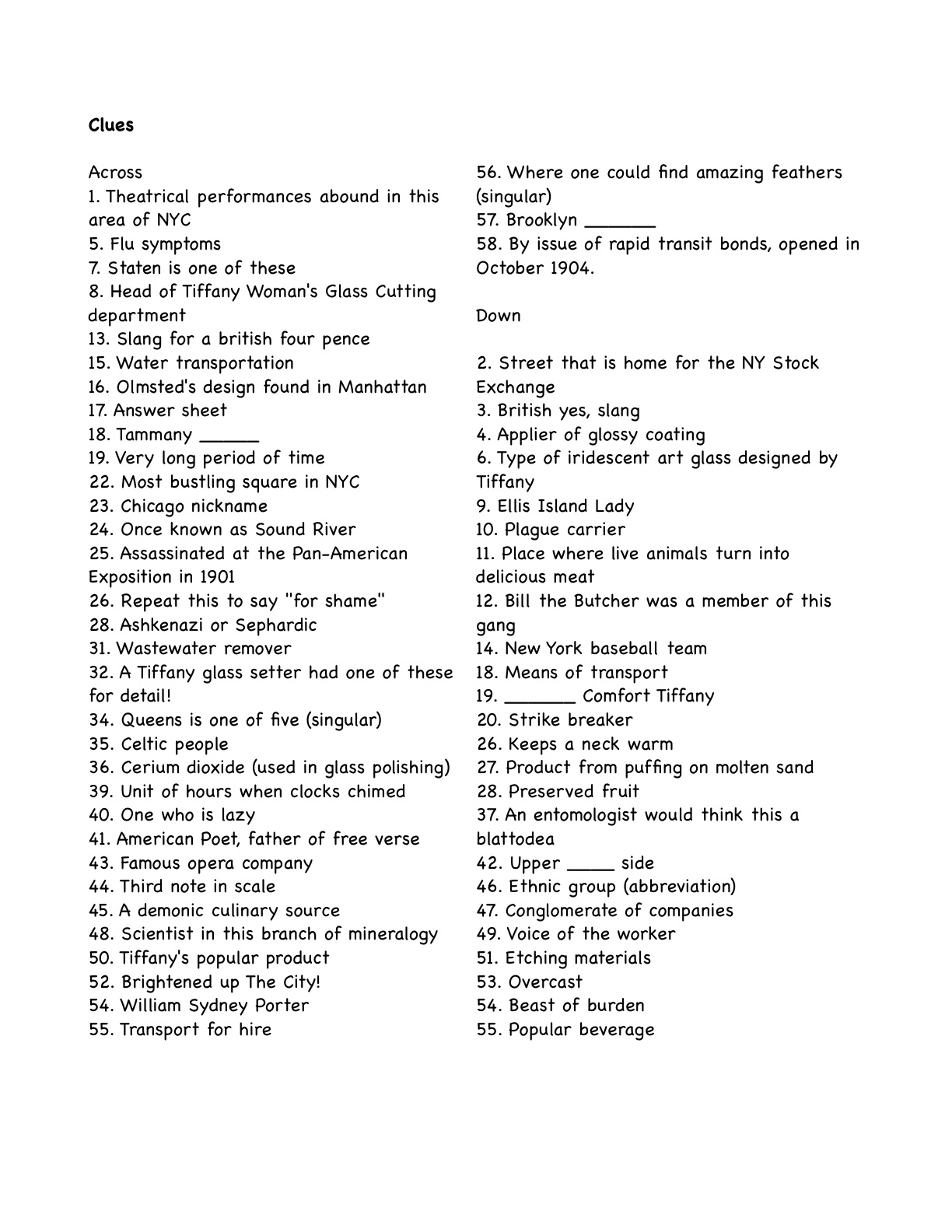
Turn of the Century New York City Crossword Puzzle for you!

Hi there book friends!  I've worked super hard, and made a crossword puzzle based on the book Clara and Mr. Tiffany written by Susan Vreeland.  The puzzle keeps with the theme of 1900's New York City.  It was a lot of fun to make, but more work than I thought!  I will post the answer key in around a week.

I would use google to help with some of the answers (esp if you didn't read the book).   Not all clues are applicable to the book, but they keep in the theme.

If you would like a pdf version, email me and I will be happy to send that to you. At this time, I do not have a link to this file that you can download ;-(

Wednesday, August 10, 2011

Destruction, Disaster, Armageddon, No Hope At All!

That is my summary of this book!  Before I go and say some good things about The Story of Edgar Sawtelle, I would like to make a definite statement that this would not be a good book club read - at least not the kind of book club I would like to enjoy, where the novel is considered a work of art that has the ability to help enhance and understand our own lives through member relationships and discussion. 

First, it was well written, set in a rural Wisconsin dog breeding and training farm.  Nice, right?  Then, let us make this even more interesting with great and unusual characters.  As this 560 page novel worms its way into the reader's life, he/she learns to care for these wonderful characters.  The most interesting is Edgar, a mute boy who is quite literate in writing and signing.  Almondine, Edgar's closest friend and canine nurse maid, has a true voice in the story.  There are other interesting dogs and Edgar's caring parents, Trudy and Gar.  Time is spent developing the history of the family and the farm.  Wroblewski even gives us a great plot with the addition of a villain, Uncle Claude!  All these pieces make a wonderful story.

Now, let me explain why this book ticked me off so much.  In the last chapter, he totally ruins his plot, the tale's mood, and any hope for any of the characters. I would never suggest to an author that his ending should change.  After all, this is fiction, the authors slate, to do with as he pleases.  Frankly though, I feel betrayed by this book's ending, to the point that twenty years from now, if I have the pleasure of still being part of the human race, I will remember the horrible ending to this book - it was that dramatic.  I will never again read another book by Wroblewski.  Others can enjoy his art, and then see him throw a stinky dog turd right into the middle of the Mona Lisa.  Crap.  I won't make the same mistake twice.

Since this blog is about good books to read, I would like to suggest Watership Down.  This classic book, published in 1972, is an excellent read about talking rabbits who have been displaced from their warren by a farmer.  This novel is totally worth the 608 page reader investment.  It is a classic that can be reread with great pleasure.  So, readers, spend your time reading something that is truly a great book.  Though talking rabbits sounds crazy, the book is really about human nature and ethics and is enjoyable for adults as well as high school students.

Wednesday, August 3, 2011

New York City Fiction, Love, War, Magic and Guts

Hamill's entertaining novel, Forever,  delves into the history of New York City starting in 1740 and concluding with the fateful day of 9-11-2011.

To show us the history of the city, Hamill most cleverly created an immortal Irish character, Cormac O'Connor.  The story starts in Ireland where Cormac is a child living under English Protestant rule, but secretly schooled in the Gaelic religion.  This part of the book was absolutely fascinating, taking me into a world I have never read of before this time.  Cormac comes to New York City, and at that time is granted eternal life provided he does not leave Manhattan.  This contrived situation acts as a great setting for the author to share the history of New York City with his readers.

This book was imaginatively constructed, entertaining and educational.  Hamill wove his tale with care.  It was quite fun to be introduced in a fictional setting to indentured slavery, the black slave trade, the American Revolution, the cholera epidemic, Boss Tweed and his group of faithful political crooks and even more.  The book seemed a bit choppy as it went from one sub plot to the next, with the setting moving forward in time often in great leaps and bounds, but if viewed as a collection of time glimpses into NYC, it was quite nice.

Other acclaimed books he has written that aren't quite such a reading commitment (this was a 640 pager) are A Drinking Life and Snow in August, though he has twenty books under his hat! Snow in August would be my choice for a good reading group discussion book due to its length and clearer material focus (as opposed to Forever which was focused on the history of NYC, and took forever to read!). Set in post WWII Brooklyn, this coming of age novel is rich with moral, racial and ethic issues as the relationship between an Irish Catholic boy and a Rabbi are developed into a tale. 

Hamill has a nice web site, http://www.petehamill.com/, where you can catch some video and get to know a little more about this prolific author and his latest works. He knows NYC, and writes about what he knows!

Monday, July 25, 2011

Women, Stand Up for the Right to Work! Fired When Married!

This book completed with a bang.  Vreeland's Clara and Mr. Tiffany: A Novel finally brought some historical excitement into her tale in the last third of the book where, finally, the historical woman's right to work issue was addressed!

"It was we, the people; not we, the white male citizens; nor yet we, the male citizens; but we, the whole people, who formed the Union.... Men, their rights and nothing more; women, their rights and nothing less"  Susan B. Anthony


Our book meeting revealed that I was not the only person that felt that Vreeland may not have researched the common Victorian behavior in the early 1900's with respect to Clara's character.  We questioned such actions such as:
  • Would it be considered proper in a boarding house to have men come in and sit on your bed? 
  •      Is it OK to keep the company of men without an escort?
  •      Is it OK to retire to bed with a man in your bedroom?
  •      Is it OK to spend the weekend at a beech house with your male and female friends?
    Vreeland painted Clara as a very discrete and proper lady, which seemed to be at odds with some of her behavior in the novel.

    The end of the book concluded with some meaty topics that were presented beautifully.   I wish these topics such as the relationship between unions, business and woman's work rights with supporting historical stories would have been described throughout the book rather than concentrated at the end of the tale.

    The author did an awesome job describing the struggles of the immigrants.  Most everyone enjoyed the historical setting and the sprinkling of American history in the telling of the story.  We had an interesting discussion with respect to the male/female love relationship within the workplace which is as applicable then as it is now, as often married employees find themselves attracted to coworkers.

    Though not the best book of the year, it was an enjoyable book club read, and lead to a pleasant discussion.

    Tuesday, July 19, 2011

    Clara and Mr. Tiffany, Susan Vreeland

    We are going to meet on Saturday to discuss this book, and I wanted to solicit opinions.  I am looking forward to seeing the Tiffany exhibit at the museum.  Matter of fact, I think that it will be awesome, and I praise the book club member who came up with that idea!

    First, for anyone who needs to catch up, this is a fictional account of Clara Driscoll who was director of the Tiffany Studios' Women's Glass Cutting Department in New York City around the turn of the century. Clara and her team of women chose the colors and type of glass to be used in the studios' famous glass items.  Women did not have the right to join the union, and were fired if they married, making this era interesting to discuss.  This well written book is a comfortable trip into Clara's life.

    I am still reading this, but should be finished by Saturday.  So far, I am finding this OK, but not compelling to read.  Granted, it is historical fiction, but it isn't thick with plot, which is why it is a bit slow for me.  Pretty much, I'm seeing Clara seeing color and beauty in something, and then translating the art into glass as she matures one chapter at a time.  Her bohemian existence in a boarding house filled with other eccentrics and artists is interesting, but not compelling.  Discussion about women's issues will be interesting, but again, not page turning material.  The setting in the early 1900's is very attractive, but still, I'm not on the rail with this book (yet).

    So, what do you think?  I'll summarize comments if anyone wants to make any to share on Saturday.

    Later, K.

    Saturday, July 9, 2011

    Unrequited Love, Mystery, Criminals, Hangings, 19th century London

    My great expectations, that is to read a great classic, have been dashed in the reading of Great Expectations, written by Charles Dickens.  This has been a CHORE to read, though not without humorous moments, surprising twists and amusing characters. Turns out, this soap opera like book was written in a series of short chapters to be published in serial form.  This restricted the writing of the tale to installments of "roughly thirty-two pages of fifty lines per page.  ... To achieve so many cliffhangers, plots had to be large and complex with a lot of action" (CliffNotes, Great Expectations by Debra Bailey, 2000 Wiley Publishing, Inc.).  

    Additionally, the writing style is difficult to adjust to, and many sentences remain undecyphered to me, usually referring to some context of the era.  However, after the first few chapters, it becomes quite readable with the understanding that some sentences one just stumbles over, yada yada yada,... even with footnotes.

    I do not recommend this book for a book club read.  It isn't without value, heavens knows it has been parsed and analyzed ad nauseam.  It is quite worthy a read in a study of Dickens, London in 1860, and the social problems of this time.  Many students are strong armed into reading this.  I'm sure they learned something; I did.  The setting is magnificent, and Charles Dickens spins a good tale. The bottom line for me was that it was interesting, but it just wasn't fun.  Perhaps if I was living in 1860 England, I would be first in line to buy the magazine containing the next chapter.  After all, I do like a good serial story (Dallas, Weeds, Breaking Bad, Dark Shadows, to name a few old and new). Alas, it is 2011, this isn't my language, and when put into a chapter/novel format, the connections between the characters are unbelievable.

    I would recommend watching the movie.  If you do want to read the book, it is available on-line for free at the Gutenberg Project.  I own the Penguin Classics edition, and would rather curl up with a book, carry it, eat lunch over it, and scribble notes than read it on-line.

    What did you think of this book?  I'm now off onto the book club discussion book, Clara and Mr. Tiffany: A Novel.  Happy reading!  K.

    Thursday, June 30, 2011

    A Con Artist, Comedy, People Falling off of Towers, Clay Men with Firey Eyes, Pigeon Dung

    I stumbled upon this book at the library, and what a gem it is!  Going Postal written by Terry Pratchett is the 33rd of the Diskworld novels, and I know I will need to read some more!  I've not read fantasy for quite some time, but this is delightful.  The story is set in a mechanical world (Diskworld) with believable characters in an environment where magic, time warps, vampires, golems (clay men who never sleep and are programmed to serve) and more exist.  What really sold me on this book though was the humor, in site into human behavior, and a mechanical email system (called the Clacks).  The Clacks is a system where people relay twitter length messages across many miles across the Grand Trunk (in our world the Internet) by moving a mechanical bit flipper (states are on or off, binary code).  The people in the next clacks tower (in a high and dangerous position) visually pick up the message and relay it, and in that way the message travels, like the pony express galloping mail across the US.  There was even the concept of a Clacks virus (there is no equivalent for Norton anti-virus) along with hackers.
    I haven't stopped laughing.  Even the characters names are funny - lets see, Moist Von Lipwig (the protagonist and a very cunning con man, who is trying to make the post office 'work'), Adora Belle Dearheart (a smart woman whose kiss is like kissing an ashtray, who runs a golum rental service, and who Moist would like to date) Reacher Gilt (the bad guy and head of the Grand Trunk), Tolliver Groat (a hardworking postman who smells like cough medicines and old potatoes), and my favorite, Mr Pump (a clay man who is Moist's parole officer, but used to be a pump in a very deep well for many centuries).  Oh, and pigeons (and their dung) are prolific in the wreck of the post office, and there are other wonderful characters.

    The final treat is that there is a UK DVD series dramatized, http://sky1.sky.com/going-postal.   This is quite a fun web page to explore.   And now, a trailer so you can see first hand what a golum looks like!