Saturday, February 25, 2012

11/22/63 by Steven King

11/22/63 I've been a fan of Steven King my whole adult reading life.  He has a home down style that keeps the reader turning pages.  However, not everything he writes is great.  And, though I can say many good things about this book, this 849 paged reading investment was not great.  However, it was entertaining, fast and fun to read.

What really captured my interest in this book was a tunnel that  transports Jake (aka George) from the present (2011) to the same location but a different time, namely September 9, 1958.  Jake inherits, from a dying friend, the tunnel knowledge along with the idea that it would be good to  prevent the assassination of John F. Kennedy. To do this he has to hang out in the 50's and early 60's for 5 years.  If things aren't going good, he has the option to go back to the tunnel and start over again, a "redo", in September 9, 1958.

King is the master of horror, and this he does quite well. There are many monsters.  One of my  friends claim that time is the monster, but I disagree. Time is more of a victim.  It turns out that that this story has many human monsters (such as Lee Oswald, and other murderers in this story), but the number one monster is reveled as ole Jake the time hopper.

King was particularly clever with his idea of being able to do a "redo"in case the future (which was altered when the past was visited) wasn't what was intended.  I also loved his depiction of Derry, Maine, and the links with a previous novel, "It".  If you have never read "It", the clown monster has just hibernated in Derry at the same time that Jake passes though.  We get to revisit a few of our beloved adolescent characters from "It", Beverly and "Beep Beep" Richie.  This was delightful.

Why wasn't this a great book?  King gets off the story line, and subplots you to death with a very long love story between Jake and a gal he meets in Texas.  It was fun to read, but was too long.  The main subplot was like a book within a book.  If his editor would have done the job he/she was supposed to do, this could have been a great book, but it has a problem with too many words.  Additionally, his time travel story (with respect to such things as the butterfly effect) doesn't always make sense.  He tries to make up for this with some lame explanation regarding time threads. King takes you along this long story line trying to prevent the assassination of JFK, and then with no warning, some really dramatic things happen that aren't explained even in his fantasy world.

The last thing I don't like about this story is his hatred of Dallas.  I happen to love Dallas, living there a good portion of my childhood and some of my adult life. Dallas was charming, the city of entrepreneurship, sky scrapers, oil money, helpful people and fast new freeways!  Granted, there was a quiet racial segregation in the city that was typical in the1960's and 70's, but this city was and is full of a free and abundant human spirit where liberty and capitalism prevail.  King personally (in his afterward) judges Dallas as a city of extreme hate.  Heck, if he does this to Dallas, he should pretty much despise Texas, or why not the whole Southern US?

"Some people will protest that I have been excessively hard on the city of Dallas.  I beg to differ...  Dallas was an hateful place.  Confederate flags flew rightsize up...  It is better today, but one still sees signs on Main Street saying HANDGUNS NOT ALLOWED IN THE BAR" King states in his Afterward.

Seems to me that this is a statement about King's political views on the racial issues the whole country struggled with, and, what else, gun control? In a state where gun ownership is common and it is possible to have a permit to carry a concealed weapon, it seems pretty reasonable to have a sign like that in a bar.  What is your point, Mr. King?

My recommendation for a great fantasy/horror genre would be Neil Gaiman's American God's.  Now, that was a great book!  However, for a good time, 11/22/63 is just fine.

Friday, February 10, 2012

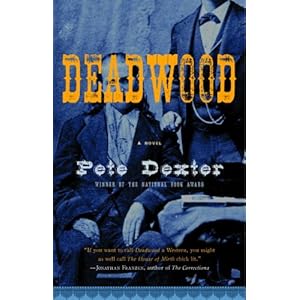
Deadwood by Pete Dexter

Deadwood This is one crazy dirty book, but then that was what life was like in Deadwood, Dakota Territories, 1876. I picked this book up at the Adams Museum in Deadwood South Dakota, one of the nicest small town museum I have ever been to. The people of Deadwood are proud of their history, and the museum clerk recommended this book as a great view of post civil war life in Deadwood.

This book is divided into five parts, rather than chapters. We meet characters such as Wild Bill Hickok, the famous sharp shooter, Calamity Jane, the well meaning dirty mouthed slutty drunk, Charley Utter, the business man and side kick of Bill, Al Swearingen, the nasty perverted whore-man and saloon owner and many more interesting characters. What makes this book interesting to me is that it actually is historical fiction. Bill was really killed by Jack McCall, and Deadwood really was one dangerous, muddy, wild gold prospecting town that paid real money for severed Indian heads.

If you say that because you saw the cable series Deadwood (it was great) you know the story hence you don't want to read the book, please reconsider. The series was focused on the process of Deadwood becoming an organized city and had different story lines. On the other hand, if you want to meet the whore Lurline Monti Verdi and find out what is up with Charley Utter's "peeter", than this is the book for you.

All seriousness aside (ha!), this isn't the kind of book that would go over in my nice ladies book club. Matter of fact, I tried to share it with a male friend who likes to read Westerns with all the saloon girl antics and gun fights, and he didn't make it past the first few pages. On the other hand, I found it down to earth, funny and just crazy enough to read in my current demented state of mind. You are put into the situations with no pretense of literature. It was surprisingly well written.

And, now for a tasteless taste of Deadwood (the book), and may I say I'm having a heck of a time trying to find something that is not offensive to copy from this text.  You can't make people in the past politically correct, because it is the past? Right?

For context, Nuttall and Mann's Number 10 is a salon, and Bill has taken a liking to Pink Buford's bulldog. Matter of fact the two love each other.

"Charley found Bill back at Nuttall and Mann's Number 10, shooting glasses off the head of Pink Buford's bulldog. The bulldog was fearless. As soon as Bill set a shot glass between the animal's ears, the dog would put his tongue in his mouth so his head wouldn't jiggle, and set dead still while Bill drew one pistol or the other and shot it off. Bill was careful at first, aiming, but the dog proved steady, and by the time Charley came in looking for him, Bill was lining up a left-handed, over-the-shoulder shot in the mirror"

That image makes me smile!  But, be warned, the book is tragic.  Alas, lawlessness brings out the worst in many people.

Saturday, January 28, 2012

It is good to see Katherine back to reading and posting.

Thought I'd just share a short list of books I've read over the last quarter of 2011 and those from current month (January 2012). Note that commas are not entered, author last name first. Added few short comments:

Paretsky Sara Bitter Medicine 9/11 
(her mysteries are good, solid, and captivating)
Rendell Ruth (writing as Barbara Vine) Anna’s Book 9/11 
(an excellent way to write a diary novel)
Walls Jeannette Half Broke Horses 9/11 
(don't enjoy her magazine style all that much)
Hiaasen Carl Sick Puppy 9/11 
(it's cute)
Oates Joyce Carol Broke Heart Blues 9/11 (not the best of her, but she's still a fav author)
Gerritsen Tess The Sinner 10/11 
(don't need any more of her I'm thinking)
Shields Carol The Stone Diaries 10/11 
(this was OK, not what I expected)
Carhart Thad The Piano Shop on the Left Bank 10/11 
(fantastic, but you should be interested in music and especially loving pianos and clever people)
Maxtone-Graham John The Only Way to Cross 10/11 
(coffeetable book, have had it for years, wonderful)
Winspear Jacqueline Messenger of Truth 10/11 
(mystery discussion group, a lot of us don't like her all that well)
Wilde Oscar The Picture of Dorian Gray 10/11 
(great classic, should be in the mood, though)
Rendell Ruth The Vault 10/11 (one of her new ones - just terrific as always)
Leon Donna Drawing Conclusions 11/11 
(her Venice is getting a bit less complex, rather bland)
Clark Robert Dark Water: Flood and Redemption in the City of Masterpieces 11/11 
(non fiction, history, not a good read per se, but lots of information)
Parker T Jefferson Silent Joe 11/11 
(another mystery discussion book, the men loved it)
de Rosnay Tatiana Sarah’s Key 11/11 (intriguing WWII story, group is going to watch the DVD soon. This put me to 52 books read for 2011)
Paretsky Sara Hard Time 11/11 (yes, she is good, still!)
Penzler Otto (ed) Christmas at the Mysterious Bookshop 12/11 
(another mystery discussion, short stories, some were really dumb, but if you've been to NYC you can endure)
Plain Belva Whispers 12/11 (skipped a lot in middle - author is not a favorite - I gave away any others of hers I had on my shelf) 

Kraybill Donald R Amish Grace 12/11 
(non fiction, was a disussion book, very revealing)
Allende Isabel House of Spirits, The 12/11 
(she has ups and downs as author, I think I'll leave her alone for a while)
See Lisa Snow Flower and the Secret Fan 12/11 (missed putting on list earlier)
Buchanan Cathy Marie Day The Falls Stood Still, The 12/11 
(KL's gift to me, not what I expected, but an OK read - am passing it around my discussion group friends because of local interest)
Atwood Margaret Handmaid’s Tale, The 12/11 
(really dumb, and I was warned, too)
deMoor Margriet Virtuoso, The 12/11 (also pretty much a waste of time)
Bohjalian Chris The Double Bind 1/12 (I am building up my admiration for him! Such good development of characters and what an interesting topic. I recommend his work)
Bragg Rick Ava's Man 1/12 (such well-written tales, biography of his grandfather)
Grafton Sue V is for Vengeance 1/12 (not at her best)
Sayers Dorothy L The Nine Tailors 1/12 (I thought this would be long and tedious, but it sped right along and was wonderful. What a classic of the English genre)
Peters Elizabeth The Night of Four Hundred Rabbits 1/12 (a waste of last night it goes in trash, what was I thinking. Oh, cute cover.)

Wednesday, January 25, 2012

The Color of Magic by Terry Pratchett


The Color of Magic


This book was a trip; a true psychedelic weird adventure. The first in a series of 39 Discworld books (Wikipedia notes as of September 2011), Pratchett introduces us to his wacky flat word that rides on four continent sized elephants that are on the back of Great A'Tuin the giant turtle that lumbers through space (hopefully not to meet a mate anytime soon). Yes, this is totally weird, but I'm sure there is a parallel with Earth that could be exposed to meteors, crashing planets, exploding stars or flips in polarity. Prachett pokes fun at us in clever ways through this wacky collection of four story-chapters.

Rincewind, the wizard, kicked out of wizard school for looking in forbidden magic books, has been forced (under threat of death by city's mayor, or "Patrician") to guide Twoflower, the tourist, through his scrappy home town, Ankh-Morpork. The destruction of the town unfolds as Twoflower introduces incredibe wealth in the manner of tips of gold coins and inn-sewer-ants policies into impoverished Morpork. The book is divided into four parts, each a new outrageous experiment in humor-fantasy.

If you read this work of very strange art, laugh and enjoy every word. The new vocabulary may on first glance be words of nonsense, but they were chosen to be words that are similar to words you do know. Morpork, for example, is More Pork? , Perhaps the word Rincewind makes you think of someone as hard to pin down as rinsed wind? This book is written for the strange by the strange, so hop on board for dragon rides and magic!

This wasn't a popular discussion book in our group. Matter of fact, I think there were some really unhappy people with this choice, so for your regular woman's book club, I would steer clear. However, if you like fantasy and have never tried this author, you should read one of his books. My guess is that Mark Twain would have loved these books, due to the incredible amount of parody, imagination, and no-nonsense nonsense. A web search indicates that good choices would be Night Watch, Small Gods and Going Postal (which I read and really really liked).

I would also like to add that this author has won awards for his discworld novels, and was also a best selling UK author in the 1990's.

Monday, October 17, 2011

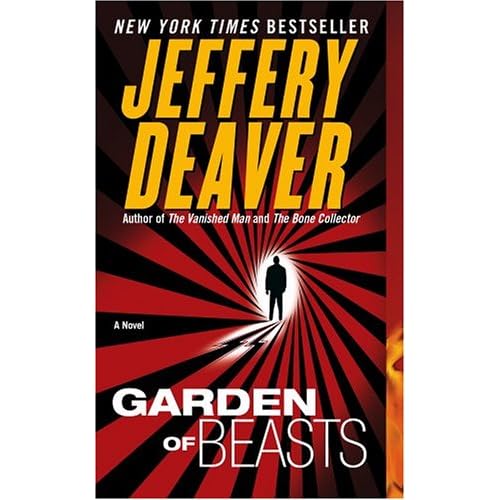
Garden of Beasts by Jeffery Deaver


Garden of Beasts

This was an entertaining, historical fictional page turner that took me into the world of Nazi Germany's 1936 Berlin during the Olympics.  This exciting read is told from the viewpoint of an American assassin, Paul Schumann, who has been promised forgiveness from his mob assassinations by the US if he will kill one of the (fictional) Nazi leaders, Reinhard Ernst, for the Department of the Navy. 
This story is told in a time before World War II, when Hitler was attempting to form his conquering armies in spite of the Treaty of Versailles where Germany agreed (well, by a twist of arm, they lost WWI) that not only did they cause WWI but they agreed to have an extremely limited military.  Deaver created a work of art, not telling, but showing the reader the mood of Berlin, where everyday Germans were terrorized by government thugs known as "Brownshirts", or the SA. Jewish shop owners are attacked, and worse....

He wrote his story, alternating between the viewpoints of diverse characters.  Our hero, Paul Schumann, is busy negotiating Berlin's underground, trying to figure out how to get a bullet through Ernst.  Ernst is busy successfully surviving the hostile politics of Hitler, Goering (head of SS) and Goebbels (minister of propaganda).  Kohl of the Berlin Police (known as Kripo) is on Paul's trail for a murder he did not commit.  One can only hope that Paul gets Ernst before Kohl catches Paul.

The story was totally fun, deep in history, and has many discussion points.  I would recommend this book for discussion.

One curious thing is that there is another book titled In the Garden of Beasts written by Eric Larson.  This book was chosen by my book club, and I accidentally picked up the wrong book.  They were both about Nazi Berlin, but In the Garden of Beasts was not fictional, and was set in 1933.Though I haven't read the one I was "supposed" to read, after our reading group meeting, I'm convinced I had a lot more fun reading this book! No complaints here!  Many complaints from others regarding In the Garden of Beasts.

Tuesday, October 4, 2011

The Heart is a Lonely Hunter, Carson McCullers


The Heart is a Lonely Hunter
Read this book, and you will visit this sad, lonely group of people, living in a economically depressed town in the South, during the Great Depression, during a time of racial injustice, hunger for many, and yes, lack of health care. 

I think if you would like to appreciate how wonderful it is to live in our current Great Recession, you should read this book.  In the 1930's, lack of health care meant that there was no hospital that would save you; no doctor to see if you didn't have the money.  Hunger was not relieved by food stamps.  Jobs were scarce.   Life was tough.

This novel is centered around five main characters.  Four of the characters are strongly passionate about their aspirations.  There is the old black Dr. Copeland who believes in Marxism, the young Mick Kelly who wants to compose music, crazy Jake Blout who wants to teach people about economic injustice in America, and Biff Branon who through a true love for his fellow man wants to ease suffering.  These characters all gather around their friend, deaf-mute John Singer, of whom each believes he understands their passions.  He doesn't.  As you read this book, you believe that each of their aspirations can be obtained.  In the end, McClullers crashes this, and doesn't give us much hope for any of her characters in this novel.  It is surprisingly entertaining for a novel with about zero plot, though one could argue that there are five strong subplots.  Each subplot tells a sad story through a purposeful character.

This is an Oprah Book Club book, the perfect place to find every sort of human misery put into literature.  The stories of the five main characters are told to make, what I think, is a point that we are basically inconsequential, sad creatures who struggle in a horrible world.

The following is referring to Biff, the do-good er and owner of an all night cafe.

"For in a swift radiance of illumination he saw a glimpse of human struggle and of valor.  Of the endless fluid passage of humanity through endless time.  And of those who labor and of those who .. love.  His soul expanded.  ... Between the two worlds he was suspended.. The left eye delved narrowly into the past while the right gazed wide and affrighted into a future of blackness, error and ruin"

I think I'll throw myself off a bridge now.  Nah, maybe just have a glass of wine to kill the pain.

Yes, this book is a masterpiece.  It is well written, makes you care about the rich characters, has a point, keeps you interested and turning pages as the motivations and horrendous problems are laid out on these pages.  It would make a great discussion book.  However, for a book club pick, my personal preference would be for something with more hope and fun.

I would like to recommend To Kill a Mockingbird, by Harper Lee as an alternative.

To Kill a Mockingbird


Readers, do you know of a great book, set in depression era America, that leads you with more hope that you would recommend?

Monday, September 26, 2011

Retired Math Professor Breaking Bad! Pot Trafficking, Explosions, Guns, Hookers, Prison!


As a new-bee first semester University of New Mexico student, 17 years old and terrified of Calculus I and the thick 1000 paged text book, I watched in trepidation as this tall, long haired, blue jeaned, leather booted professor sauntered into the classroom.  This was a time where calculators were most likely pencils or slide rules, Mitchell Hall (one of the classroom buildings) wasn't wired and punch cards were used to communicate with computers.  I watched, as he slowly paced cat like, from one side of the room to the other, occasionally licking his lips, obviously in deep thought (one could only hope it wasn't because he was hungry for Freshmen).

Picking up a piece of chalk, we all watched in anticipation of a complex formula, or convoluted Mathematical idea that would cause us to rush to the registrars afterwards to find a new section, or perhaps change our major (what good is engineering anyway?).  Turning to face us before writing, he most seriously stated "This is a very important book that everyone here should read".  Our hearts expired, please not another book we thought.  Back to the board he wrote, "Zen and the Art of Motorcycle Maintenance."  Smiling, we knew this would be an interesting math class, and he did not disappoint us.

I have to confess, I haven't read that book, and he still passed me onto Calculus II.  But, what I did read was his 2005 self published book, "The Golden Years of Jess Martin". I loved it, but then I always liked listening to Jeff talk, and his voice in the book is the same as his voice in person.

I read this book in 2008, so I will not review this from my memory.  Instead, I will copy the review I wrote back in 2008 from Amazon.  However, separate from that review, I recall that it got really wild and crazy, and I've always wondered if the fictional blowing up of the humanities building (that is the building where the Math department used to live) had a deeper meaning.  The end of the book didn't hold together as well for me as the first half, though the whole book was really fun to read.

This would not make a good book club discussion book, but is a dirtier, lighter "escape from reality" book to read.

So, here is the Amazon review (dang it, the Amazon criminals won't let me copy and paste it, so here is a retype):

This was an extremely entertaining book, fast paced, unpredictable, with great characters. The characterization of Jess and the people he deals with was realistic;  written by an author who understands people and their motivations.  You will even find yourself having sympathy for a double crossing hooker!

This was similar to Breaking Bad, a new cable series, but where the chemistry teacher (turned bad) uses chemicals to solve his drug business complications, Jess uses mathematical logic that has tastes of higher level thinking to conquer the messes that go hand in hand with pot trafficking.

I found the settings of a prison in CA, the bar and society in Southern NM near the Mexican border well described and interesting.  I only wish Jess could have retained some of his innocence, as I really liked the character who was a newbie, but after enough time in the business, it just wasn't possible.

I think the best thing about this book was that I couldn't predict what was going to happen next.  I am hoping for a sequel.