Monday, May 5, 2014

The Book Thief by Markus Zusak
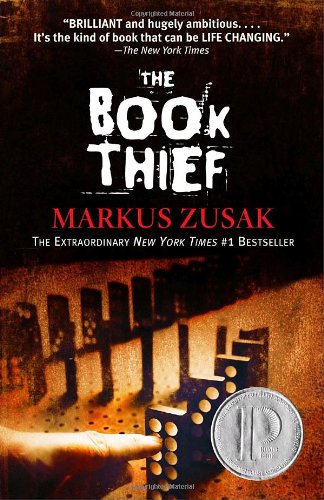

  The Book Thief "The Book Thief" by Markus Zusak is an absolute work of art. Even though the story has been made into a movie, film would never be able to capture the author's style of imaginative narration chosen to weave his tale.

This story is narrated by the grim reaper who holds a fascination and love for man.  Death uses color to describe the moment he takes a soul into his arms the way we would describe the weather.  In Death's dutiful and busy labor during World War Two, he (she? it?) observes a very spirited little German girl, penned "The Book Thief", whose story he feels worthy to tell.

The author takes us into the world of a poor neighborhood in Munich, where we meet Liesel Meminger growing up in a foster home in Germany as her whole world tumbles into Hitler crazed politics.  The story, as told from the view point of German citizens, also victims of an evil regime that drove to control the soul of the people, casts light on their innocence.  We visit, through Liesel's eyes and heart, the forced depravity of the Jew, the terror of having your homes bombed, and the embodying fear of being convicted for your private thoughts.  Your neighbors could not be trusted, which was why Hitler was so successful in the appearance of national support.

At this point, I would think you would be running away from this book; who can withstand to relive such pain?  However, the redeeming qualities of love, perseverance, and the energy and hopefulness of youth, as recognized by our dear grim, make this book a page turner.  The nontraditional format of child-like illustrations, lists and special bolded points make this also an entertaining book to read.  I would also like to add that Zusak does an astounding job with his characters, both evil and good, making this one redeeming quality of this war story.

The realities of World War Two must be revisited upon us and our children.  They must know what happened, even if it was from the viewpoint of a child.  This would be an excellent book not only for a book club, but also for a teaching platform.  We should all be reminded that free thought, free speech, and our rights as a free citizen in a country where no one is persecuted by our government on the basis of race or belief is a treasure that we must all work to preserve.  It can be lost, and once we forget this, it will be.


Thursday, October 10, 2013

Gone Girl, Gillian Flynn wins the "Kay Book of the Year" award

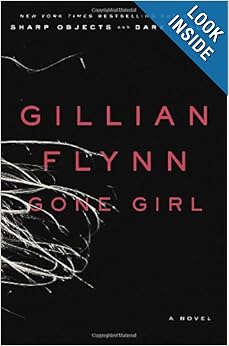
Gone Girl Gone Girl was one of those reads that I didn't want to end, certainly it gets the "Kay Book of the Year" 2013 award (though published in 2012, I read it only this year).

What do I look for in a book that I would aspire to an award by moi?


  • It needs to be unpredictable.  Nothing worse that dragging through a book with no surprises.  Matter of fact, I'm still not even sure how the darn thing really ended, which I'm sure was the authors' intent.  The story takes 3 huge twists, each written as a different section.  The construction is brilliant.
  • I want to live in someone's life that isn't at all like mine.  I was never the spoiled NYC rich girl, and I certainly have never been kidnapped. 
  • Literary cleverness and/or amazing prose is a must, and though this story has more of the clever part and less of the breathtaking prose, the descriptions are very excellent.  For example, consider this most excellent runoff sentence.  "I was tucking her in properly and our faces were close, and her cheeks were a merry holiday-sledding pink, and it was the kind of thing that could never have happened in another hundred nights, but that night it was possible."  Nice?  The words take you away.
  • It needs to be well written by someone with a command of the English language better than my own. 

  • I haven't decided yet if this is chick lit as it is a love story, kind of, and a murder mystery, sort of, with a solid dash of sociopathic and other interesting personalities, and enough turns in the very compelling story to make you dizzy.

    This would be a fun choice for a book club discussion, or a nice present for a mature female friend.  I had read some great reviews, so I purchased it for our annual book club Xmas party exchange in 2012.  It ended up back to me after Y. had finished, and it will continue to circulate among our members.  I am excited to see what they thought of the ending.

    I can't wait to tear into Gillian Flynn's other novels, Sharp Objects (2007) and Dark Places (2010).  I'm hooked now.

    Monday, April 22, 2013

    Galileo's Daughter by Dava Sobel

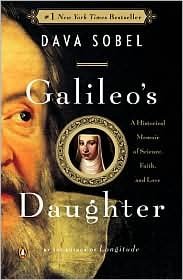
    Galileo's Daughter I can't speak highly enough about this novel! It was well researched, and a delight to read.  This book both educates and entertains.  You will learn not only about life in the late1500's and early 1600's in Florence and Rome, but also about the works of one of the greatest scientist the human race has known.  Galileo's life was during a plague (of rodent type)  ridden politically charged time of censorship within a religious based dictatorial government.  The political situations were thick; there were inquisitors, the 30 Years' War (major, like WWII, but confined to Europe), and Pope Urban VIII who cared more for power than the Catholic faith.  Pope Urban VIII was personally insulted by Galileo's writing (with the help of self serving political advisors) which sent him on the path to destroy this gem of science. 

    The title is misleading.  This book is about Galileo Galilei, not Sour (Sister) Maria Celeste, his illegitimate daughter that he placed in a convent at age thirteen.  The author takes you through Galileo's life, sprinkling letters received from his daughter in each chapter.  Throughout their lives they were in continual service to one another, be it through confections, medicines (Sour Maria was an apothecary), repaired clocks, new window frames, or encouragement through correspondence.

    Other delights are the many pictures and the appendix showing a scientific timeline.  Not to be overly grim, but one of my favorite images was the sketch of the plague doctor.  They would strap on a beak, filled with flowers to ward off plague vapors.  Before reading this book, I thought they did this just to look special!

    The Galilei genealogy was something I continued to refer to throughout the reading.  His family played a huge part in his life.  Galileo fell into the roll of the rich grandfather or uncle who continually had family members begging for money (including Sour Maria Celeste) or semi permanent lodging (due to war or life mismanagement).  He had a very generous caring nature, and never did he turn them away.

    Is this a good book club selection? It depends on the book club.  Not every chapter is exciting, so there may be a bit of slogging through to be done.  If you have little interest in scientific experimental discovery, if you are not interested in Renaissance Italy and you perhaps have no interest in astronomy, then you are doomed to hate this book.  However, if the group has some foundations in science or history, then there is much to discuss.

    History repeats itself, and I hear the parallel arguments between religion and science today.  In Galileo's time, the heresy was that the earth is not the center of the universe.  Today, religion and science are still in conflict, only the topic of discussion has changed to the big bang theory or the evolution of man.  The difference is that the pendulum has certainly swung in the interesting direction of science as a religion (which isn't very scientific either).  On the other hand, often the other side will not consider scientific evidence because they feel that it conflicts with their religious beliefs.  They both need Galileo's intersession, where there is room for God and science.

    Thursday, November 8, 2012

    The Immortal Life of Henrietta Lacks, Rebecca Skloot

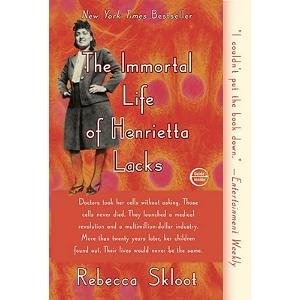
    The Immortal Life of Henrietta Lacks This is a worthy book to read, awesome to discuss, educational, enlightening, but not really exciting.  As a book club choice, it belongs with a group a pretty serious people who are excited to discuss the legal issues of genetic ownership, the history of human guinea pigs in the 1950's, black social issues and other serious issues regarding medicine, the law and social inequity.

    Ho hum.  Give me sex and rock and roll (that is just my mood thing, not to discourage you on your path to understanding the world).

    This book was written by a journalist, digging and finding golden information regarding the history of the magical HeLa cell.  Skloot was amazing in her search of not only the story of tissue used in research, but into the family history of Henrietta.  Her persistent digging into the story of Henrietta's cells as seen by the family members resulted in her meeting and befriending Henrietta's daughter Deborah. They develop a relationship that results in Skloot getting the real scoop.

    Cells usually die.  They don't grow forever in a lab, but have an end life after a certain number of divisions. But, Henrietta Lacks had some cancer cells removed from her body in the 1950's that happened to not die because cancer cells don't do what healthy cells do (in this case divide a finite number of times).  These particular deviant cells grew and divided in clumps and mounds, were cultured and then shared by John Hopkins with other research labs.  Eventually, the HeLa cells (named using the first two letters of her first name followed by the first two letters of her last name) became a popular medical research medium, used in research such as the development of the polio vaccine and gene mapping.  They were used and still are used in medical research today.

    This was a great book.  One of the book club members commented that she would like to see this required high school reading.  I think that is a good idea for certain classroom situations, but perhaps not to be mandated.

    If you are interested in this subject, sure, read this book.  It is worthy of your interest.  If not, then pick up some nonfiction that perhaps is.  Personally, I find medical history books quite interesting.  Another one that I enjoyed was Virus X: Tracking the New Killer Plagues by Frank Ryan.  What an interesting discussion for the lay person about AIDS, Ebola, etc...  

    Saturday, August 25, 2012

    The Sweetness at the Bottom of the Pie by Alan Bradley

    The Sweetness at the Bottom of the Pie In spite of the fact that this was a horrible name for a book (who can remember that name?  and I found only a weak connection between the name and the book's content), and in spite of the fact that I usually don't read mysteries because I don't like them (and this was "A Flavia de Luce Mystery"), this was a pretty darn good book.

    Set in the 1950's in the family owned once-grand mansion of Buckshaw, we meet a most interesting and delightfully entertaining group of characters.  Flavia de Luce, our sleuth, is a precocious 11 year old girl with a pendant for chemistry and a particular love for poisons.  She lives with her widowed reclusive father, and two older sisters Daphne (Daffy) and Ophelia (Feely) where book reading and rivalry rules.  In the opening chapter we find Flavia dissolving Feely's inherited pearls that had "belonged to Mummy" much to Feely's horror.  And, that is only the start of it!

    The murder takes place by Chapter 2, and it is up to Flavia to untangle who killed the man that had been visiting Father the previous evening.  She found the victum layed out in the family cucumber patch, expressing his last breath. The book is well written without any nastiness that would offer it an R or probably even a PG-13 rating.  It is clean, entertaining, and quite British.

    I'm happy to see that Alan Bradley has many more Flavia mysteries to entertain us.  Any of these books would make great gifts to adults and adolencent readers alike.  It isn't a great discussion book, but would be fun for a lighter mystery or dinner party oriented reading group.

    Mr. Bradley became a first time novelist in his 70's, and I'm sorry he waiting so long to start! His writing is good and prolific.   In 2007 he won the Debut Dagger Award of the (British) Crimewriter’s Association for this novel.  Check out the web site http://www.flaviadeluce.com/view-authors-bio/for more bio information, a list of his Flavia mysteries, and an opportunity to join his fan club!

    Friday, August 17, 2012

    The Orphan Master's Son, Adam Johnson

    The Orphan Masters Son This is a great discussion book, but takes the cake for the most depressing book of my literary lifetime.  I even think this beats Fyodor Dostoyevsky's Crime and Punishment  for the unhappy literature award.  Basically you have all the makings of a great book.  The setting is interesting; placed in North Korea, it is in a land few of us understand.  The book is very well written, matter of fact I can say that this book is well engineered.   The author left us with the most positive ending possible by saving some of the characters you grew to care about.  The story of life in this dreadful country is told through a young male orphan, Jun Do.  We travel with him as he lives, from a horrible existence to "as good as it gets".

    Enough said, this book was extremely dark.  There is a level of torture described as I've not read before; there are heartbreaking scenes that reveal North Korea as the truly evil dictatorship that it is.  Do not read this book to be happy, read this book to see what it means for a whole nation of people to be imprisoned.

    The trip taken by the North Korean group to Texas was a goofy addition to the book.  What was the author thinking of, I know not.  He did tie the story line together, but it seemed very unbelievable.  He seemed to show us more about how unfair a country is when there are no personal liberties.

    There is a lot to discuss, however as a group discussion book, this belongs in a book club like the Marquis De Sade's Book Readers, or perhaps the Political Atrocities Literary Society.  Our book club enjoyed Korean BBQ while we discussed this, but if we were true to form, we would have had a little bit of rice and vegetables and gone home hungry.

    Sunday, March 18, 2012

    Three Good Books to Read

    Hi there! A dear friend has chosen three books she considers good reads.  The book club will be choosing one of these books.  Here is what she has picked:

    1)   The History of Love by Nicole Krauss.  I have read this books, and  I think it is a good book club selection book.  Published in 2006, this 250 page read will be widely available and a relatively quick book to read.  In my opinion, it is well written and interesting. 

    The following is from the Amazon.com review:

    The History of Love spans of period of over 60 years and takes readers from Nazi-occupied Eastern Europe to present day Brighton Beach. At the center of each main character's psyche is the issue of loneliness, and the need to fill a void left empty by lost love. Leo Gursky is a retired locksmith who immigrates to New York after escaping SS officers in his native Poland, only to spend the last stage of his life terrified that no one will notice when he dies. ("I try to make a point of being seen. Sometimes when I'm out, I'll buy a juice even though I'm not thirsty.") Fourteen-year-old Alma Singer vacillates between wanting to memorialize her dead father and finding a way to lift her mother's veil of depression. At the same time, she's trying to save her brother Bird, who is convinced he may be the Messiah, from becoming a 10-year-old social pariah. As the connection between Leo and Alma is slowly unmasked, the desperation, along with the potential for salvation, of this unique pair is also revealed.

    2)  The Guernsey Literary and Potato Peel Society by Mary Ann Shaffer and Annie Barrows. This book is on my stack of books to read, given to me by another reading friend who thought it was wonderful. Published in 2009, this 290 page book will also be quite available as a used or a library book.  It looks to me to be a delightful book to read.

    The following was taken from Annie Barrows website (see http://www.anniebarrows.com/otherbooks/  for the complete book description)

    January, 1946: London is emerging from the shadow of the Second World War, and writer Juliet Ashton is looking for her next book subject. Who could imagine that she would find it in a letter from a man she's never met, Dawsey Adams, a native of the island of Guernsey, who has come across her name in a book?  ....
    A celebration of the written word in all its guises, The Guernsey Literary and Potato Peel Pie Society is the debut novel by the aunt-and-niece team of Mary Ann Shaffer and Annie Barrows.

    3)   365 Thank Yous by John Kralik.  This is a non-fiction that the recommending reader has read and found inspirational.  This was published by Hyperion in 2010,  is 240 pages, and has what I can see as only 2 amazon reviews.  It is non-fiction, and I have to admit, it does sound pretty inspirational.  My Mama always told me that you can't catch flies with vinegar.

    From the author:
    A Simple Act of Gratitude is a book that tells the story of an inspiration, the writing of 365 Thank You Notes, and how my life was changed by the people who received them.  You can read more at his website, and even send a thank you to someone from his site (http://www.365thankyounotes.com/)